The Indestructible Pie
How a South American Meat Extract Became a British Working-Class. A brief history of the Fray Bentos Pie
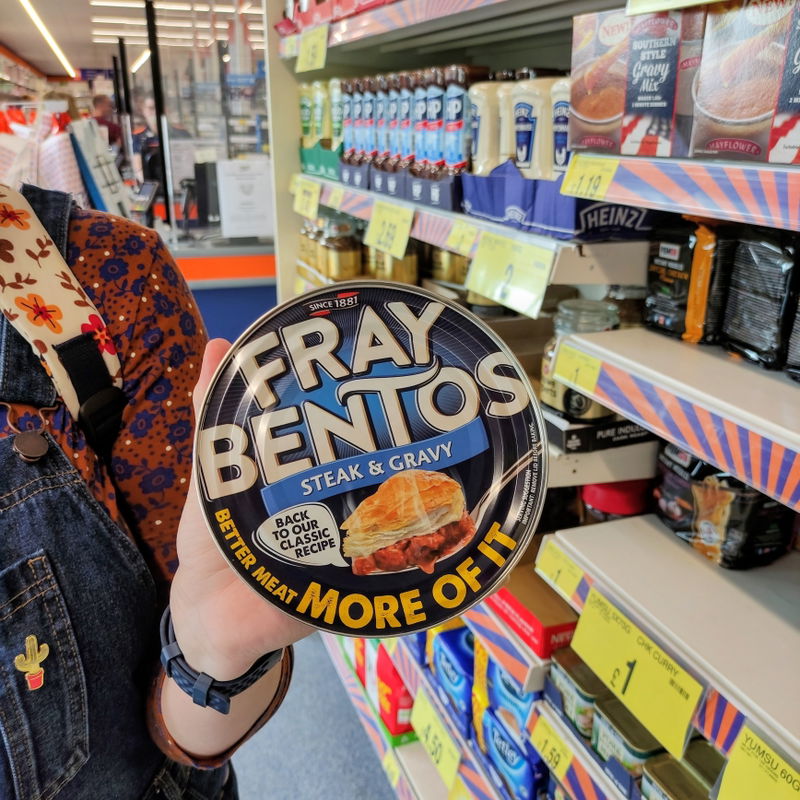

Whatever you might think or feel about the concept of hermetically sealed pastry and meat in a flat tin can, there is considerably more to it than first meets the eye. The Fray Bentos tinned pie is a profoundly paradoxical item in our national culinary consciousness: an engineering marvel that somehow manages the commercial wet sterilisation of protein and the preservation of raw pastry within a single container. It is, by any reasonable measure, a stroke of genius — not least because it has achieved this while looking, in its finished state, like something that has been thrown against a wall three times.
To dismiss it as mere convenience food — as its more vocal critics are wont to do—is to miss something important. The Fray Bentos pie is simultaneously a marvel of applied thermodynamics, an artefact of the British Empire's global logistical reach, and a deeply contested symbol of working-class culinary identity. To understand what this tin actually is, you have to follow it back to where it began: not Hackney, not Scotland, but the killing floors of Uruguay in the mid-nineteenth century.
I should note upfront that my primary reading companion in all of this has been Pete Brown's Pie Fidelity: In Defence of British Food, which I can recommend without reservation to anyone with even a passing interest in the subject. It is comprehensive, properly argued, and engaging in a way that food writing frequently promises but rarely delivers. I have supplemented it with various fragments of internet research, sources for which I am happy to supply on request.
The South American Crucible (1840s–1860s)
The beginning of the nineteenth century brought with it a rapid acceleration of technology and industrialisation across Europe. It was the age of the factory and the railway, and it was also the age of mass urbanisation — rural populations pouring into cities that were entirely unprepared to feed them. The result was widespread urban malnutrition on a scale we would now find difficult to comprehend. Protein, in particular, was both scarce and expensive for the working poor.
It was this crisis that preoccupied Justus von Liebig, a German chemist working in the 1840s. Von Liebig developed a highly concentrated meat extract — Extractum carnis Liebig — in 1847, with the explicit intention of providing affordable, portable nutrition to populations that could not access fresh meat. The science was sound. The economics were not. European cattle were prohibitively expensive, and the cost of scaling production to any useful level was simply beyond the reach of the enterprise.
The solution to this problem arrived in the form of an engineer named Georg Giebert, who had been paying attention to South America. Uruguay, in the mid-nineteenth century, possessed something that Europe desperately lacked: practically limitless supplies of cattle, and correspondingly low prices for them. The pampas were full of the things. Backed by British and Belgian capital — because there was always British and Belgian capital available for this kind of venture — Giebert and his partners formed the Liebig Extract of Meat Company, known as LEMCO, in 1865. Their production facility was established in the Uruguayan town of Fray Bentos, on the eastern bank of the Uruguay River.
What emerged at Fray Bentos was not so much a factory as a monument to industrialised efficiency. The plant processed up to four hundred cattle per hour, employing a cosmopolitan workforce of five thousand people drawn from across Europe and South America. It earned, without any apparent irony, the nickname "The Kitchen of the World." The sheer scale of the operation was breathtaking by the standards of the time, and the beef extract it produced began flowing into European markets with increasing volume through the latter half of the century.
War, Logistics, and the Birth of the Pie (1870s–1950s)
LEMCO expanded its product line in 1873 with the introduction of tinned corned beef, sold under the Fray Bentos name. This turned out to be a decision of considerable historical consequence. Tinned meat's properties — long shelf life, compact form, no requirement for refrigeration — made it exactly what military logisticians had been looking for. Fray Bentos corned beef became a staple of British field rations across three separate conflicts.
During the Boer War it fed soldiers on the South African veldt. During the First World War it became so ubiquitous in the trenches that a British Mark IV tank — sealed, impenetrable, and apparently capable of surviving almost anything — was nicknamed "Fray Bentos" by the men who crewed it. During the Second World War, it was issued to troops in North Africa, where it acquired the affectionate and somewhat sardonic nickname "Desert Chicken." In each case, the product performed its essential function: it kept people alive under conditions where fresh food was not available.
By 1924, LEMCO had been acquired by the Vestey Group, a British company with extensive interests in the global meat trade. It was the Vestey Group that recognised, in the post-war period, the extraordinary brand equity that decades of military association had produced. British consumers, particularly those who had lived through rationing, knew the Fray Bentos name and trusted it in the specific, unshowy way that people trust something that has proved reliable under pressure. In 1958, seeking to capitalise on this loyalty and on the enduring British affinity for baked savoury goods, the company began manufacturing the product that would become the iconic tinned meat pie.
There is a pleasing geographic irony here. Despite its Uruguayan origins, pie production was established domestically, in the London Borough of Hackney. The Fray Bentos pie was, from its inception as a pie, a British-made product — Hackney-manufactured, South American-branded, and carrying the accumulated cultural weight of sixty years of beef extract and military field rations.
Public Health Crisis and Corporate Evolution (1960s–Present)
Not everything about the brand's history is triumphant. In 1964, Fray Bentos suffered the kind of catastrophe that tends to follow companies for generations.
The Aberdeen Typhoid Outbreak of that year was traced to a microscopic defect in a single tin — one can, among millions, that had developed a hairline fault during the cooling process and had consequently been contaminated by untreated river water used in that process. The resulting typhoid epidemic spread through Aberdeen with alarming speed, infecting hundreds of people. The public health and reputational consequences were severe.
The outbreak, combined with the shifting trade tariffs of the following decade, proved devastating for the original Uruguayan facility. The plant at Fray Bentos — the same site that had once processed four hundred cattle per hour and called itself the Kitchen of the World — closed in 1979. It sat largely dormant for decades before being recognised for what it actually was: a monument to a particular moment in industrial history. In 2015, UNESCO designated the site a World Heritage Site. There is something appropriately strange about the fact that the factory that made the tin that caused a typhoid outbreak is now a protected heritage site. The twentieth century was not short of such ironies.
The brand itself survived, as robust brands tend to do. It passed through the hands of Campbell's and then Premier Foods, before being acquired in 2011 by Baxters, the Scottish family firm better known for soups and preserves. Production of the pies was relocated to Fochabers in Moray, where they are manufactured to this day. The product is now, therefore, Scottish — which is its own kind of journey for something that began on the banks of the Uruguay River.
The Science of the Sealed Pie
The Fray Bentos tinned pie presents a genuine engineering problem, which is perhaps why it tends to attract a certain kind of admiring curiosity from people who think about these things for a living.
The central difficulty is this: you must achieve commercial sterility — eliminating all viable microbial life, including the exceptionally resilient spores of Clostridium botulinum — without destroying the raw puff pastry sitting on top of the filling. These are not easily compatible requirements. The conditions necessary to kill botulinum spores are, under normal circumstances, the same conditions that would reduce delicate laminated pastry to something resembling damp cardboard.
The solution is retort canning, specifically a process calibrated to achieve what food scientists call a "12D" botulinum cook. The sealed tin is placed inside a large industrial pressure vessel — a retort — and heated to 121.1 degrees Celsius. At this temperature, held for a precisely calculated duration, Clostridium botulinum spores are eradicated. The pastry survives this process in a raw state because it has been formulated and positioned to withstand it; the tin's geometry and the precise lamination of fats in the pastry are not accidental.
What the consumer then does — and this matters — is bake it in a conventional oven. This step is not optional, and it is not merely a warming instruction. It is the completion of the cooking process. Oven heat causes the laminated fats in the pastry to melt in sequence; the water within the pastry vaporises and becomes steam; that steam mechanically forces apart the pastry layers, creating the characteristic lift and rigidity of a properly baked puff crust. The result is the slightly improbable spectacle of a tin that emerges from a domestic oven containing something that is genuinely, structurally a pie.
Microwaving it, incidentally, will not achieve this. You will end up with a hot, grey, structurally ambiguous disc, and you will deserve it.
Sociological Resonance and the Middle-Class Sneer
Pete Brown's Pie Fidelity offers a framework for understanding why the Fray Bentos pie produces such strong reactions — in both directions — and it begins with what he identifies as a fundamental severance.
The Industrial Revolution did not merely move people from the countryside to the city. It restructured their entire relationship with food. The grinding schedules of factory work — twelve-hour days, six days a week, for wages that left little margin — made scratch cooking not a lifestyle choice but an impossibility. Working-class families needed food that was calorie-dense, cheap, required minimal preparation, and could be relied upon not to kill anyone. Tinned goods, including eventually tinned pies, answered all of these requirements. The Fray Bentos pie is, in this sense, a direct material consequence of the Industrial Revolution and the economic conditions it imposed.
This history is largely invisible to the critics who refer to the pie as "dog food" — a dismissal that has its own social cartography. The middle-class food culture that elevated the artisanal pork pie, the hand-crimped pasty, and the carefully sourced terrine did so from a position of economic security that allowed for choices about provenance, preparation time, and what is now called terroir. The Fray Bentos pie is precisely the opposite of terroir: it is hyper-industrialised, standardised, and designed to be identical in Hackney and Huddersfield and Aberdeen. This is a feature, not a flaw. For the people it was made for, consistency and reliability were not aesthetic failings — they were the point.
For millions of people in Britain, the Fray Bentos pie is a Proustian trigger of considerable power. It is tied to specific memories: a particular kitchen, a particular childhood, a particular version of being looked after with what was available. The sneer directed at it says more about the sneer-er than about the pie. Nostalgia is not a less authentic emotion simply because the object of it was manufactured in bulk.
Cult Status and the Apocalypse Paradigm
The Fray Bentos pie's relationship with time is one of its more unusual qualities.
Its legal Best Before date is set at three years, which covers optimal taste and texture. Beyond this point, the pie will begin to degrade — the pastry may soften, the flavour may flatten — but the tin itself will remain microbiologically safe for significantly longer, provided it has remained undamaged and properly sealed. The retort canning process that sterilises the contents also, by definition, makes them stable against microbial spoilage indefinitely. There is no theoretical point at which a structurally intact Fray Bentos tin becomes unsafe to eat, which has earned the product an enthusiastic following among a particular kind of preparedness-minded consumer.
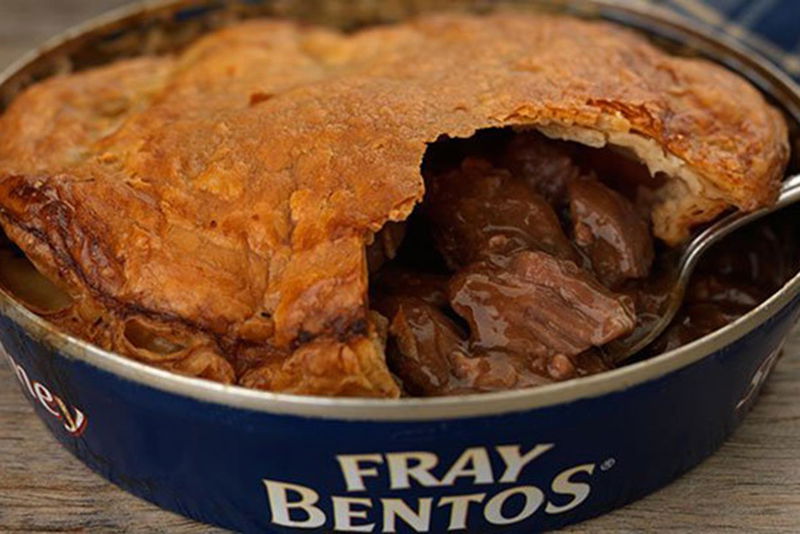
The COVID-19 lockdowns of 2020 provided an inadvertent market study in this regard. When British consumers began stockpiling in anticipation of supply chain disruption, Fray Bentos pies became one of the more sought-after items on supermarket shelves. This was partly logic — the pies are calorically substantial, long-lasting, and require only an oven and a tin opener — and partly something harder to quantify: in a moment of genuine collective anxiety, people reached for the thing that felt safe and familiar. The Fray Bentos pie was both practical provision and comfort object, which is a combination very few products can honestly claim.
The brand has continued to adapt, in the slightly self-aware way that heritage products sometimes do. There have been collaborations with MasterChef winners. There is now a vegan Balti option, which would have been genuinely incomprehensible to the LEMCO shareholders of 1865. These updates have not noticeably diminished the core product's standing. The tin endures, flat and unprepossessing on the supermarket shelf, carrying its accumulated history — of Uruguayan cattle, of battlefield rations, of typhoid outbreaks and UNESCO listings and Hackney factories and Scottish production lines — without drawing any particular attention to it.
Which is, when you think about it, rather British.
Primary reading: Pete Brown, Pie Fidelity: In Defence of British Food. Sources available on request.

Comments
No comments yet. Be the first to comment!